


Amazon isn’t just a store; it’s one of the most powerful search engines on the planet, with a “Buy Now” button attached to nearly every query. Every time someone types into the Amazon search box, they’re giving you a live stream of demand data — and at the same time, they’re asking the algorithm to decide which products deserve to be seen first. That decision is driven by Amazon SEO optimization.
For brands, that means organic visibility is no longer a nice bonus. It decides how much you’ll spend on ads, how often you’ll win against similar products, and whether new launches gain momentum or die quietly on page three. Brands that treat Amazon SEO as a system — not a one-time task — typically pair listing improvements with account-level Amazon management to keep performance consistent across the full catalog.
Amazon’s own official guidance says that SEO, when done well, is a win–win: it helps shoppers find the right products faster while helping sellers increase sales and brand visibility.
In this article, we’ll go deeper than generic advice and align your strategy with how Amazon itself says search works: from the search box and filters to Best Sellers Rank, Sponsored Products, and listing quality. We’ll walk through the full Amazon SEO guide — keyword strategy, listing structure, conversion assets, common mistakes, tracking, and FAQs — so you can build a system that keeps working long after you hit “publish.”
If you still treat Amazon like “just a marketplace,” you’re leaving profit on the table. Treat it like a search engine, and Amazon SEO optimization turns into your most reliable growth channel.
TL;DR – How to Do SEO for Amazon Products
At a high level, seo for Amazon comes down to three pillars working together:
- Relevance:
Use the same language your customers use. That means building a keyword strategy, then placing those terms intelligently in your title, bullet points, description, backend search terms, and even image alt text. Amazon explicitly recommends combining both short-tail (“shoes”) and long-tail (“vegan leather brown loafers”) phrases to capture broad demand and specific buying intent. - Retail readiness & listing quality:
Your listing must be complete: include a clear title, informative bullets, a strong description, correct attributes, high-quality images, and a mobile-friendly layout. Weak content hurts both ranking and conversion. - Performance:
Amazon rewards what sells. Click-through rate, conversion rate, review health, price, delivery options, and account health all sit at the core of Amazon marketplace SEO and determine whether your product moves up or slowly fades.
If your amazon seo strategy aligns with these three, the algorithm starts treating your listing as the “obvious answer” for target search terms — and that’s when organic sales really compound.
What Is Amazon SEO and Why Does It Matter
Amazon search engine optimization is the process of improving how often and how prominently your products appear in Amazon’s search results, category rankings, and recommendation surfaces. Amazon’s own blog defines it as a set of strategies — keyword research, content optimization, image improvements, and pricing adjustments — that together increase product and brand visibility in search.
But what makes Amazon SEO different from Google SEO is intent. On Google, a user might be researching, comparing, or just browsing. On Amazon, they’re usually ready to buy. That makes every impression more valuable and every lost click more expensive.
Amazon also publicly outlines five components of how search works in its store:
- The search box, where customers type queries and see auto-suggested terms.
- Search filters, which narrow by price, delivery speed, reviews, and more.
- The search results page, where customers compare offers side-by-side.
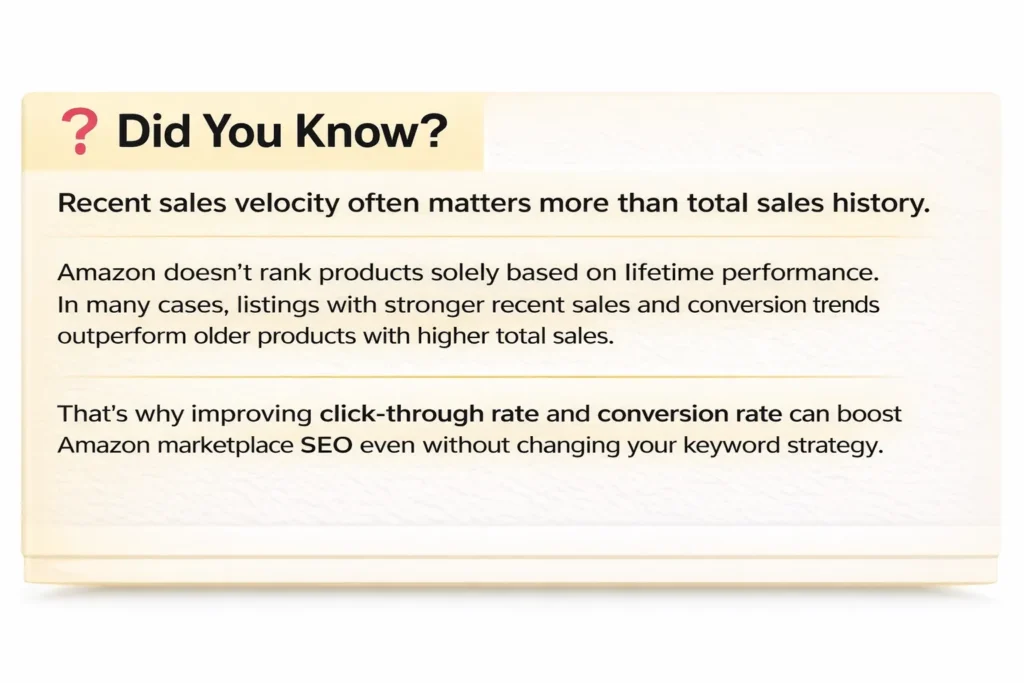
- Amazon sales rank / Best Sellers Rank, which reflects recent sales velocity.
- Sponsored Products and other ads, which can elevate offers above or among organic results.
Your job is to ensure that when a customer navigates through all of that, your products appear with sufficient relevance and strong enough performance that Amazon keeps you visible. A strong SEO strategy for your Amazon store doesn’t just lift one listing — it improves the discoverability of your entire catalog, especially when you stack Sponsored Products and organic rankings with your Amazon ads strategy.
Core Ranking Factors in Amazon SEO
Under the hood, Amazon’s A10-driven system is asking one core question: “Which product is most likely to satisfy this query and generate a sale?” That answer is based on both content and behavior.
1. Relevance: Do you match the query?
Relevance is where Amazon search terms optimization lives. Amazon looks at your:
- Title
- Bullet points
- Product description
- Attributes and category
- Backend search terms
- A+ and image alt-text (to a lesser degree)
If your content doesn’t clearly explain what the product is and who it’s for, you’ll struggle to get indexed, especially for long-tail, high-intent searches.
2. Click-through rate (CTR)
CTR is Amazon’s first signal that your offer might be the right answer for a search. It’s heavily influenced by your main image, price, review count, rating, and title. A weak CTR tells the system “customers saw this and didn’t care,” which undermines even the best Amazon product SEO work.
3. Conversion rate (CR)
Once the shopper lands on your detail page, the question becomes: do they buy or bounce? Conversion rate is one of the most important signals for Amazon seller SEO. Strong content, clear benefits, strong social proof, and frictionless page structure are what push those conversions higher.
4. Reviews and social proof
Amazon’s own documentation repeatedly calls out reviews, ratings, and Best Sellers Rank as key indicators of popularity and customer satisfaction. A listing with hundreds of recent, positive reviews will almost always have an easier time climbing than a brand-new listing with no proof.
5. Pricing & Buy Box stability
Amazon explicitly recommends staying price-competitive and using tools like the Revenue Calculator and Automate Pricing to manage margins and competitiveness. Price has a double impact: it affects both CTR and CR, and it influences whether your offer wins and keeps the Featured Offer (Buy Box) position, which is crucial for conversions.
6. Listing quality & account health
Amazon’s blog also highlights listing quality and account health dashboards as contributors to search rankings: poor account health, missing content, or inventory issues can suppress visibility even if your keyword setup is strong.
Together, these inputs shape your Amazon Marketplace seo footprint.
How to Do Amazon SEO Effectively
Now let’s translate all of this into a practical roadmap for optimization.
1. Build a keyword strategy the way Amazon expects
Amazon advises sellers to consider both short-tail and long-tail keywords: broad category terms for reach and specific phrases for higher conversion.
A solid keyword strategy for SEO for Amazon listings typically includes:
- Core category terms (e.g., “wireless earbuds”)
- Modifier-based long-tail terms (e.g., “noise-cancelling earbuds for travel”)
- Use-case or audience-based terms (e.g., “gym headphones for running”)
- Synonyms and alternative ways buyers describe the same item
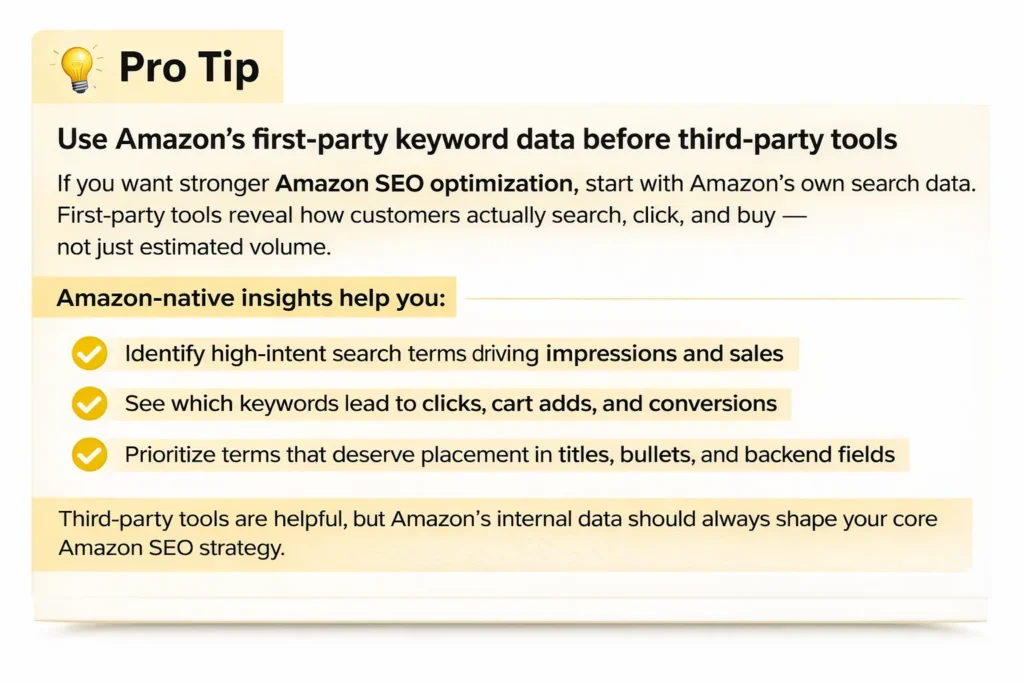
Amazon specifically points sellers to tools like Product Opportunity Explorer and Brand Analytics to track top search terms, query performance, and shifts in customer behavior — insights that are invaluable for refining your Amazon SEO strategy.
2. Turn that keyword map into a structured, human-friendly listing
Amazon’s own article breaks optimization into seven levers: keyword research, titles, descriptions, bullets, backend search terms, images, and pricing. Those map perfectly to how you should design your amazon seo guide.
- Title:
Your title is the most critical text element on your listing because it carries the highest indexing weight, influences click-through rate, and sets expectations before a customer clicks. Use your primary keyword, but keep the title concise, clear, and readable—especially if you’re applying proven Amazon listing optimization techniques across a full catalog. - Bullets:
Highlight key benefits, not just technical features. Amazon suggests starting each bullet with a short label, followed by a brief explanation written with the customer in mind. This is a great place for secondary keyword variants that support SEO for Amazon Webstore visibility. - Description:
Use this area to expand on benefits, materials, dimensions, care instructions, and warranty — all the details Amazon calls out as essential content for the detail page. Avoid keyword stuffing; Amazon explicitly warns that overusing the same phrase can hurt both experience and ranking. - Backend search terms:
Treat these as overflow for keywords that don’t fit naturally on the front end: synonyms, abbreviations, alternative product names. Amazon’s guidance is clear: avoid duplicates, keep it relevant, and use spaces, not commas.
3. Optimize your conversion assets based on Amazon’s best practices
This is where improving Amazon SEO turns from theory into revenue.
Amazon’s blog emphasizes these points for images and content:
- Use a variety of images from multiple angles.
- Highlight key features visually.
- Use clear, well-lit photos on a plain white background, with the product filling at least ~85% of the frame.
- Use alt-text on images to describe what’s shown and include one to two relevant keywords — this helps both accessibility and SEO.
Layer A+ Content on top as your storytelling canvas. Amazon openly states that A+ Content can increase sales when used well, especially when it combines rich text, imagery, and comparison charts. For Amazon SEO optimization, treat A+ as a conversion tool: it should answer questions, reduce doubt, and move the shopper closer to “Add to Cart,” boosting the performance side of the equation.
Finally, your pricing strategy needs to make sense. Amazon recommends researching competitor prices, understanding your margins, and using tools like the Revenue Calculator and Automate Pricing to find the sweet spot where you stay competitive without destroying profitability.
Amazon SEO Best Practices
Bringing it together, here are the core practices that align with both Amazon’s official advice and what top-performing brands do in the wild:
- Treat Amazon SEO optimization as ongoing, not a one-time task. Revisit titles, bullets, and backend search terms every 60–90 days based on data.
- Use a mix of short-tail and long-tail keywords across titles, bullets, descriptions, and backend fields to capture both reach and conversion.
- Write for humans first: Amazon itself warns against keyword stuffing and recommends natural, informative descriptions supported by keyword variations.
- Use high-quality product images and thoughtful alt text to improve both the customer experience and search relevance.
- Leverage Amazon-native tools like Brand Analytics, Product Opportunity Explorer, and Manage Your Experiments to test titles, images, and copy — particularly when refining advanced Amazon SEO tips.
- Keep account health, inventory, and fulfillment performance stable to avoid hidden ranking penalties.
These routines make your Amazon store’s SEO more resilient as competition and algorithms evolve.
Common Amazon SEO Mistakes to Avoid
From both Amazon’s guidance and real-world seller experience, some patterns show up again and again:
- Keyword stuffing everywhere.
Amazon explicitly calls this out as harmful: repeatedly using the exact phrase can make the copy unreadable and damage ranking. - Ignoring long-tail terms.
Sellers sometimes chase only the biggest-volume phrases. Amazon encourages using long-tail queries because they often convert better. - Weak or generic images.
Blurry photos, low angles, or lack of lifestyle imagery all sabotage conversion signals that feed back into your Amazon seller SEO performance. - Leaving backend terms blank or redundant.
Repeating your title keywords exactly in backend fields wastes valuable indexing space. - Overdesigning A+ Content.
Beautiful but confusing layouts can push customers away rather than guide them, hurting the conversion rate. - Set-and-forget listings.
In a marketplace that shifts monthly, never revisiting your content means letting competitors slowly outrun you.
Avoiding these pitfalls will keep your Amazon SEO optimization work from being quietly undone by minor but critical errors.
Tips to Track and Measure Amazon SEO Performance
None of this matters if you don’t measure results. The brands that really win at Amazon product SEO are the ones that build an analytics habit.
Here’s how to track progress in a practical, non-obsessive way:
- Monitor keyword ranking trends weekly, not daily. Look at whether you’re moving in the right direction for your primary targets rather than chasing every fluctuation.
- Watch organic sessions and sales share. If more of your sales are coming from paid traffic over time, your organic visibility is weakening.
- Track CTR and CR together. Low CTR suggests an issue with how your offer appears in search; low CR indicates a problem on the detail page. Both are central for seo for Amazon listings.
- Study returns and Voice of Customer. If customers feel misled or confused, Amazon will notice, and your Amazon marketplace SEO will pay the price.
- Use Amazon Brand Analytics and Search Query Performance dashboards (if you’re in Brand Registry) to see which search terms actually lead shoppers to your brand and where you’re losing them in the funnel.
Treat your strategy like a feedback loop: optimize → measure → refine → repeat.
FAQs
In most categories, you can start to see movement within 30–90 days after a serious optimization push, especially if you adjust both keywords and conversion levers. More competitive niches or products with a weak review history may take longer, but a consistent Amazon SEO strategy, along with paid support, often accelerates results.
From Amazon itself, the most important tools for Amazon search engine optimization are:
– Product Opportunity Explorer, for identifying top search terms, customer behavior, and niche demand.
– Amazon Brand Analytics, for Search Query Performance and Top Search Terms dashboards.
– Manage Your Experiments, for A/B testing titles, images, and descriptions to see what actually moves the needle.
Pair those with third-party tools (Helium 10, DataDive, Jungle Scout, etc.), and you have a powerful stack for Amazon SEO tips, testing, and iteration.
Yes. A+ content itself isn’t a direct ranking factor in the same way titles or backend terms are, but it absolutely influences conversion rate. Overly complex modules, tiny text, or content that doesn’t match the main listing can confuse shoppers, reduce conversions, and indirectly harm your ability to improve Amazon SEO.
A good default is to refresh key SEO elements — title, bullets, images, backend terms — every 60–90 days, unless you see a sharp decline in traffic or sales earlier. Use a controlled approach: test one major element at a time, using tools like Manage Your Experiments, rather than changing everything at once.
Conclusion
Amazon rewards clarity, relevance, and performance. When you align with how Amazon itself says search works — by combining smart keyword research, structured listing content, conversion-focused assets, and disciplined pricing — Amazon SEO optimization stops feeling like guesswork and starts behaving like a system.
By leveraging Amazon’s own data tools, keeping your listings human-first, and continuously improving based on real shopper behavior, you build durable rankings instead of temporary spikes. That is the real edge: not just showing up for a few keywords today, but owning your category long-term through smart, evidence-based Amazon SEO.