

Amazon Prime is frequently misunderstood by third-party sellers.
Many treat it as a shipping program. Others pursue it purely for badge optics. Some assume that Prime eligibility automatically guarantees sales growth. What most sellers fail to understand is that Prime is not a shipping upgrade, and it is not a cosmetic label. It is a structural variable inside Amazon’s conversion, ranking, and Buy Box systems. When used deliberately, Prime becomes conversion leverage that compounds revenue velocity. When misused or adopted without modeling, it compresses margins and destabilizes operational control.
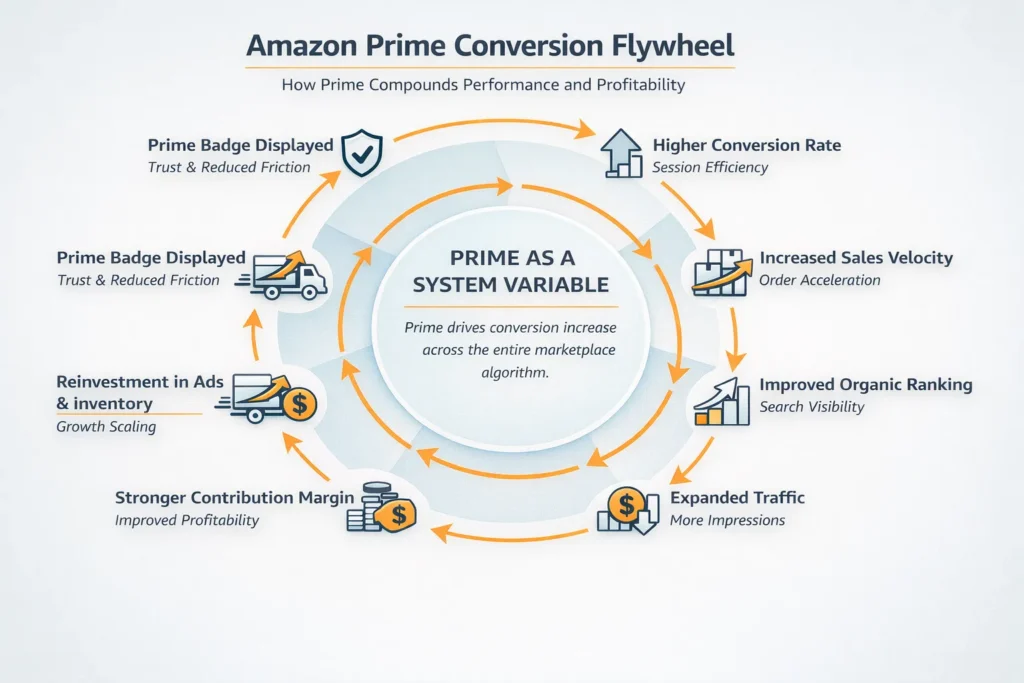
To understand Amazon Prime for sellers properly, you have to step beyond logistics and think in performance systems. Prime affects buyer psychology, which changes the conversion rate. Conversion rate affects sales velocity. Sales velocity affects organic ranking and Buy Box rotation. Organic ranking and Buy Box stability affect advertising efficiency. Advertising efficiency affects net contribution margin and cash flow stability. Prime sits at the beginning of that chain reaction.
This article breaks down how Prime actually functions for third-party sellers through Fulfillment by Amazon (FBA), and Seller Fulfilled Prime (SFP), how it influences Buy Box share, how it impacts PPC efficiency, and how to model Prime profitability before scaling. Prime is not something you “turn on.” It is something you structure.
The True Mechanism of Prime: Conversion Mathematics, Not Shipping Speed
At the product detail page level, Prime operates psychologically before it operates logistically. Buyers interpret the Prime badge as a sign of speed, reliability, and simplified returns. More importantly, they interpret it as reduced risk. Reduced risk removes friction. Friction removal increases purchase probability.
For most sellers, the conversation stops here. But the meaningful impact occurs when conversion changes propagate through Amazon’s ranking algorithm.
Let’s examine a simplified model.
Assume a listing receives 25,000 monthly sessions with an 11% conversion rate. That produces 2,750 monthly orders. Now, suppose Prime eligibility increases conversion to 13%. That produces 3,250 monthly orders, a 500-order lift without increasing traffic.
At first glance, that’s roughly an 18% sales increase.
But here is where marketplace dynamics magnify the effect. Higher-order velocity signals demand strength for Amazon’s ranking algorithm. Ranking improves. Organic visibility increases. Sessions rose from 25,000 to 30,000 due to improved placement. At a 13% conversion rate, 30,000 sessions yield 3,900 orders.
A two-percentage-point conversion shift results in 1,150 incremental monthly orders, a 41% increase in total. Prime does not simply improve conversion in isolation. It compounds across the entire ranking system.
Prime’s real power is multiplicative.
Prime and Organic Ranking: How Velocity Compounds
Amazon’s search algorithm rewards momentum. Listings that demonstrate consistent purchase activity relative to impressions gain organic visibility. Prime affects that momentum in three primary ways.
First, Prime increases conversion rate. Higher conversion strengthens listing performance metrics relative to competitors. Second, Prime stabilizes delivery expectations, reducing purchase hesitation. Third, Prime can improve Buy Box rotation, ensuring that traffic captured through advertising or organic search actually converts through your offer rather than a competitor’s.
Organic growth on Amazon is not purely keyword-based; it is velocity-based. Prime strengthens velocity if price and inventory conditions are controlled. When velocity accelerates, rankings move upward. When rankings move upward, impressions expand, feeding more traffic into the listing. If Prime remains active and conversion remains strong, the growth loop sustains itself.
Sellers who ignore Prime participation in competitive categories often face a compounding disadvantage. Even a modest conversion gap can lead to long-term divergence in ranking momentum.
Prime narrows that gap or, when executed correctly, creates a structural advantage.
Fulfillment by Amazon: Prime Through Infrastructure Stability
Fulfillment by Amazon remains the most straightforward way to secure Prime eligibility. When inventory is stored in Amazon’s fulfillment network and meets program criteria, listings automatically display the Prime badge.
The strategic advantage of FBA goes beyond Prime access. It transfers fulfillment risk away from the seller. Late shipment rates, handling inconsistencies, and regional delivery variability are managed by Amazon’s infrastructure. This insulation protects key metrics that influence Buy Box weighting, such as the order defect rate and on-time shipping performance.
For scaling brands or sellers operating without advanced warehouse operations, FBA introduces stability. Stability reduces metric volatility. Reduced volatility improves Buy Box consistency. Buy Box consistency protects advertising spend. That cascade reinforces Prime’s conversion benefits.
However, FBA introduces cost layers that must be modeled rather than assumed.
Advanced FBA Margin Modeling
To evaluate Prime properly through FBA, sellers must isolate its effect on contribution margin.
Consider a product selling for $60.
- Amazon referral fee at 15% equals $9.
- FBA fulfillment fee may approximate $7.
- The average storage cost per unit could be $1.50.
- Inbound shipping averaged across units might add $0.75.
- Product landed cost equals $20.
Total fulfillment and platform fees equal approximately $18.25 before storage and inbound allocation are considered. Combined with landed cost, the total unit cost may reach $40.
Before advertising, the gross contribution per unit is $20.
Now incorporate advertising.
If pre-Prime advertising costs per order are $18 due to lower conversion efficiency, the net contribution after ads is $2. After Prime improves conversion rate and reduces wasted clicks, the advertising cost per order may drop to $14. Net contribution becomes $6.
Prime does not increase the selling price. It reduces acquisition friction. That friction reduction may generate greater relative gain in advertising efficiency than in raw conversion alone.
But if conversion lift does not materially reduce advertising cost per order, Prime through FBA may increase fee exposure without improving bottom-line profitability.
Prime must be evaluated alongside advertising elasticity.
Seller Fulfilled Prime: Control With Performance Sensitivity
Seller Fulfilled Prime offers Prime eligibility while maintaining warehouse control. Inventory remains within the seller’s infrastructure, but performance standards mirror Prime-level expectations.
For brands with multi-channel fulfillment, SFP can reduce storage fees and inventory fragmentation. Instead of dividing inventory between FBA and external warehouses, products remain centralized.
However, SFP demands operational discipline. Two-day delivery coverage, weekend fulfillment, consistent on-time shipment rates, and controlled cancellation metrics are mandatory. Unlike FBA, where fulfillment metrics are absorbed by Amazon’s logistics infrastructure, SFP performance directly affects seller account health.
Operational sensitivity increases.
Any lapse in warehouse execution may reduce Prime eligibility or Buy Box rotation. Sellers entering SFP without mature logistics systems often underestimate how tightly Amazon monitors delivery performance.
Control increases responsibility. Responsibility increases risk concentration.
SFP is not inherently superior or inferior to FBA. It is appropriate only when operational capacity aligns with Prime performance standards.
FBA vs Seller Fulfilled Prime: Operational Trade-Offs
Table Layout:
| Variable | FBA | Seller Fulfilled Prime |
| Prime Eligibility | Automatic | Conditional |
| Fulfillment Risk | Amazon-managed | Seller-managed |
| Storage Fees | Higher | Lower |
| Operational Control | Lower | Higher |
| Metric Volatility | Lower | Higher |
| Buy Box Stability | Strong | Depends on execution |
| Cash Flow Risk | Inventory lock-in | Performance penalty exposure |
The Buy Box: Prime’s Influence on Rotation Stability
The Amazon Buy Box determines which seller captures the majority of transaction volume on a listing. It evaluates delivered price, shipping speed, inventory availability, and seller performance metrics.
Prime eligibility enhances reliability perception. Faster shipping and consistent handling increase the likelihood that a Prime-qualified seller rotates into the Buy Box more frequently than a non-Prime competitor.
However, Prime does not negate price sensitivity. Delivered price remains central.
Imagine three sellers competing on the same listing.
- Seller A: Prime, $60
- Seller B: Non-Prime, $57
- Seller C: Prime, $65
Seller A may rotate into the Buy Box above Seller B due to improved fulfillment reliability and conversion probability. But Seller C’s $65 price may exceed acceptable price-elasticity thresholds, even with Prime.
Prime expands pricing flexibility; it does not eliminate it.
The strategic objective is not to be the lowest Prime offer. The objective is to maintain an acceptable contribution margin while preserving Buy Box stability. That balance defines a sustainable Prime strategy.
Advertising Efficiency Under Prime
Prime’s effect on advertising is frequently underestimated.
When conversion improves, the cost per click remains constant, while the cost per order declines. A campaign spending $10,000 at $1 CPC generating 10,000 clicks produces different outcomes at 10% versus 13% conversion.
At a 10% conversion rate, 1,000 orders are generated at $10 per acquisition. At 13%, 1,300 orders are generated at $7.69 per acquisition.
Advertising spend remains $10,000. Revenue increases. Acquisition cost declines. Margin expands.
Prime indirectly reshapes advertising economics by improving session-to-order performance. Sellers who evaluate Prime solely by fulfillment cost fail to account for this variable.
When Prime participation stabilizes the Buy Box share, advertising waste caused by losing the Buy Box also decreases. This prevents the budget from subsidizing competitors.
Offering Prime eligibility strengthens advertising efficiency when price and inventory remain stable.
Prime Day: Amplified Performance, Amplified Risk
Prime Day magnifies every structural element within a listing.
Traffic surges may double or triple. Advertising competition intensifies. Inventory turnover accelerates.
Inventory forecasting ahead of Prime Day must account for projected velocity multiplication. If a SKU normally sells 100 units daily and Prime Day traffic quadruples conversion, failing to stock adequately may result in total depletion within hours. Stockouts during high-velocity periods degrade ranking momentum and may require extended recovery.
Advertising budgets during Prime Day should scale only if the Buy Box position is secure. Scaling spend without stable Buy Box ownership channels traffic to competitors.
Prime-exclusive discounts should be modeled against the post-discount margin. A 20% price reduction, combined with increased advertising costs and the FBA fee structure, may yield high revenue but yield a negligible net contribution.
Prime Day is not a celebratory event. It is a performance stress test.
Mature operators treat it as controlled acceleration.
A Hybrid Approach: When FBA and SFP Coexist
Advanced sellers often adopt hybrid models.
High-velocity SKUs or nationally distributed items operate through FBA for stability and Buy Box consistency. Slower-moving or regionally controlled products operate under Seller Fulfilled Prime to mitigate long-term storage fees and maintain inventory centralization.
Hybrid execution requires synchronized inventory systems. Oversupply in one channel and stockout in another undermine Prime’s stability advantage.
The primary strategy should align with the overall Amazon account management architecture rather than operate independently.
A Structured Framework for Evaluating Prime
Before committing inventory to FBA or enrolling in Seller Fulfilled Prime, sellers should evaluate:
- Baseline conversion rate
- Expected Prime conversion lift
- Advertising cost per acquisition sensitivity
- Buy Box share stability
- Incremental fulfillment fee exposure
- Storage volatility
- Warehouse execution capacity
- Cash flow elasticity
Prime should increase net contribution per session, not merely the total number of orders.
If Prime increases orders but reduces net margin per order due to aggressive pricing or fee compression, growth may appear healthy while profitability erodes.
Prime amplifies both success and weakness.
The Long-Term Strategic View
Amazon Prime for sellers is not an optional cosmetic enhancement in competitive categories. It is an integral component of conversion competitiveness.
Prime reduces buyer hesitation. Reduced hesitation strengthens velocity. Velocity improves organic placement. Organic placement reduces advertising dependency. Reduced dependency stabilizes acquisition cost. Stabilized acquisition cost supports predictable margin growth.
But this only occurs when fulfillment execution and price discipline remain intact.
Prime cannot compensate for unstable inventory, poor pricing strategy, or thin product margins.
It is leverage. Leverage without structural strength increases risk. Leverage applied to strong systems compounds the advantage.
FAQs
Amazon Prime for sellers refers to participation in programs such as Fulfillment by Amazon (FBA) or Seller Fulfilled Prime that allow third-party sellers to display the Prime badge and offer fast delivery, improving conversion rates and Buy Box performance.
Prime can increase sales by improving conversion rates and purchase velocity, thereby strengthening organic rankings and potentially reducing advertising cost per order when modeled correctly.
No. Sellers may qualify for Prime through Seller Fulfilled Prime if they meet strict delivery and performance standards.
No. Prime improves competitiveness, but delivered price, seller performance metrics, and inventory availability remain significant factors in Buy Box rotation.
Not necessarily. While storage fees may be lower, operational costs, labor, packaging, and carrier rates can offset perceived savings. Profitability must be modeled.
Final Conclusion
Amazon Prime for sellers is not a badge strategy. It is a system variable.
It reshapes conversion mathematics, influences Buy Box rotation, improves advertising efficiency, and accelerates ranking momentum. When pricing, fulfillment, and margin structure are aligned, Prime becomes a long-term revenue multiplier.
When Prime is adopted without modeling, it becomes a cost amplifier. Prime does not create a competitive advantage on its own. It magnifies whatever operational foundation already exists.
The sellers who treat Prime as infrastructure, not decoration, are the ones who convert leverage into dominance.