


If your rankings disappear the moment you reduce ad spend, you do not have SEO. You have rented visibility. In contrast, a robust Amazon SEO Strategy gives you lasting, structural control and defensible market positions. That distinction separates surface-level Amazon SEO optimization from structural control of the market.
Many sellers still treat Amazon SEO as a content exercise. They refine titles, insert high-volume terms discovered during Amazon keyword research, adjust backend fields, and expect Amazon search rankings to improve automatically. While textual relevance remains necessary, it is no longer the primary driver of sustainable growth.
In 2026, the Amazon ranking algorithm evaluates sustained commercial performance. Amazon’s search algorithm favors products that demonstrate predictable sales velocity, competitive conversion efficiency, stable inventory management, and consistent buyer engagement. Keywords open the door. Performance keeps it open.
Organic ranking on Amazon is not granted because a listing is optimized only once. It is reinforced through momentum — a repeating pattern of performance signals that builds algorithmic confidence over time.
Understanding and engineering that momentum is what separates brands that briefly rank from brands that dominate.
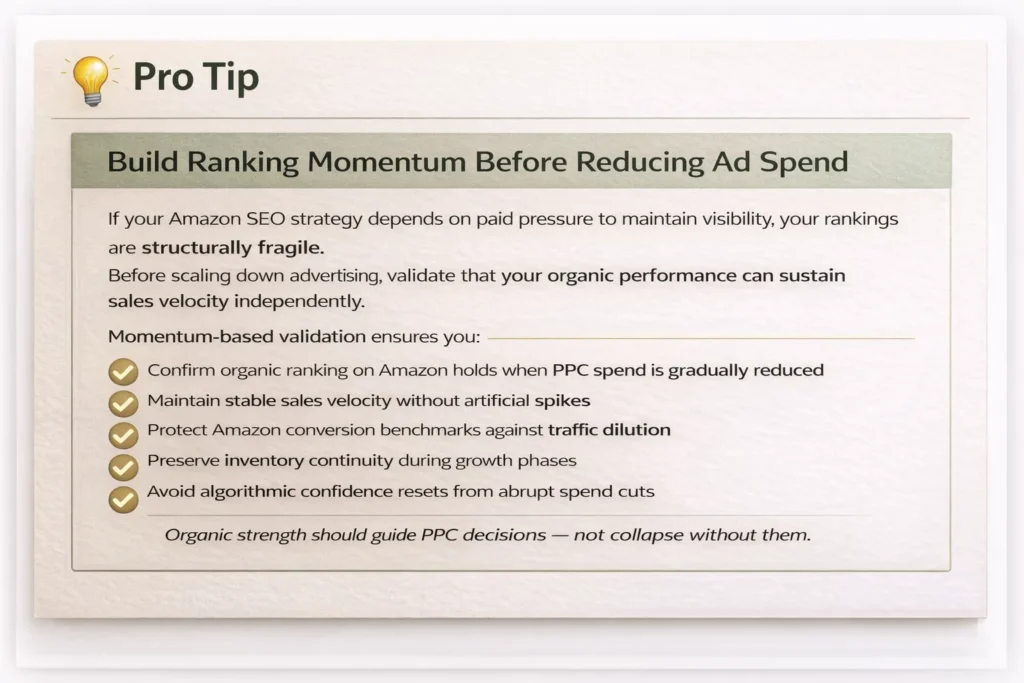
In 2026, Amazon SEO holds only when performance stays consistent. Validate a small set of high-intent keywords, win the click, convert efficiently, and protect inventory. Use PPC to support momentum, then reduce spend gradually—never abruptly.
TL;DR: Amazon SEO in 2026 Is About Momentum, Not Manipulation
Amazon SEO in 2026 is no longer about inserting keywords and hoping for higher rankings. Keywords establish relevance, but sustained performance determines visibility.
If your rankings disappear the moment ad spend decreases, your visibility is not organic strength. It is a paid dependency.
Amazon’s ranking algorithm prioritizes consistent commercial performance — click-through rate, conversion rate, sales velocity stability, inventory continuity, pricing discipline, and buyer engagement. Short-term spikes do not build authority. Predictable momentum does.
Sustainable Amazon search rankings are built through alignment between Amazon listing optimization, Amazon PPC strategy, conversion efficiency, and operational stability. Paid traffic should validate and accelerate, not artificially inflate exposure.
The objective is not to rank quickly. It is to build ranking momentum that competitors cannot economically disrupt.
Why Most Amazon SEO Fails at Scale
In the early stages, Amazon listing optimization can drive noticeable improvements. Updating titles, improving images, and adjusting backend search terms may increase indexing and exposure. However, as competition intensifies, incremental changes to content alone no longer produce a durable impact.
The primary reason Amazon SEO fails at scale is misaligned focus.
Many sellers concentrate on indexing rather than influence. They verify that their product appears for high-volume keywords but fail to examine click-through rate and Amazon conversion rate performance relative to competitors. If a product receives exposure but fails to attract clicks or convert efficiently, the algorithm reduces its visibility over time.
Another structural mistake occurs with advertising transitions. Brands often deploy an aggressive Amazon PPC strategy to accelerate improvements in rankings. Once the position improves, advertising budgets are abruptly reduced to recover margins. This sudden shift disrupts Amazon’s sales velocity consistency, signaling instability to the algorithm. As velocity weakens, ranking begins to slip.
SEO, advertising, pricing, conversion optimization, and inventory control cannot operate independently. If Amazon’s advertising strategy supports ranking growth but inventory management fails, visibility collapses during stockouts. If traffic increases but conversion efficiency remains low, algorithmic confidence erodes.
Without structural alignment, Amazon’s organic traffic becomes volatile and expensive.
How the Amazon Ranking Algorithm Interprets Performance Signals
Amazon is fundamentally a retail engine. Its algorithm rewards products that maximize revenue efficiency.
Once relevance is established through Amazon keyword research and listing structure, performance signals determine hierarchy. Three signals dominate the evaluation process.
Click-Through Rate and Search Engagement
Click-through rate indicates how often shoppers click your product when it appears in search results. Amazon compares listing performance at the query level. If your main image, pricing structure, review authority, or branding fails to win attention against competitors, exposure contracts gradually.
Improving Amazon product ranking, therefore, requires not only relevance but also competitive presentation. A keyword-rich listing that cannot win the click weakens its own visibility.
Conversion Rate and Revenue Efficiency
After engagement, Amazon’s conversion rate performance becomes critical. The algorithm compares how effectively your listing converts relative to similar products targeting the same query. When a product consistently converts at a level above category benchmarks, it signals efficiency. Efficient listings generate more revenue per impression in the marketplace, making them more attractive to Amazon’s ranking system.
This is why Amazon’s SEO strategy cannot be separated from persuasive copywriting, pricing discipline, A+ content structure, and review development.
Traffic without conversion undermines trust.
Sales Velocity, Consistency, and Algorithmic Confidence
Temporary spikes do not create ranking authority. The Amazon A10 algorithm prioritizes consistent velocity over short bursts of promotional sales. A product that reliably sells a steady volume over weeks builds stronger ranking durability than one that surges briefly under heavy advertising and then declines.
Velocity consistency communicates stability. Stability strengthens algorithmic confidence. Confidence reduces displacement probability.
Sustainable Amazon search rankings are built through repeatable performance, not promotional intensity.
Ranking Position vs Ranking Strength
Many sellers obsess over ranking on Amazon. Few analyze what protects rank once achieved.
Position is visible. Strength is structural.
Two products may both rank on page 1 for a competitive keyword. One gained visibility through temporary advertising pressure and discounted pricing. The other achieved rank through months of strong Amazon conversion-rate performance and disciplined management of Amazon sales velocity.
The first ranking is fragile. The second is defensible.
Ranking strength increases when:
- Organic ranking on Amazon grows relative to paid dependency
- Conversion performance stays above category average
- Inventory remains uninterrupted
- Pricing avoids dramatic volatility
- Advertising reinforces, rather than artificially inflates, exposure
Strong Amazon SEO does not aim to rank quickly. It aims to rank securely.
The Amazon SEO Flywheel: Aligning Organic and Paid Signals
Amazon’s SEO strategy reaches its full potential when integrated with advertising rather than kept in isolation.
Paid campaigns accelerate early keyword validation. A disciplined Amazon PPC strategy identifies queries that convert profitably. When those conversions occur consistently, they contribute to organic lift. As organic rankings improve, advertising dependence can gradually decline while total visibility remains stable.
Margin improves. Capital becomes available for expansion into adjacent keyword clusters. That reinvestment strengthens ranking resilience further.
External traffic, when properly tracked and optimized for conversion, can enhance the perception of demand diversity within Amazon’s ecosystem.
The flywheel operates as follows:
- Paid acceleration → Conversion strength → Organic lift
- Organic lift → Margin improvement → Capital reinvestment
- Reinvestment → Broader keyword dominance → Stronger ranking stability
When engineered properly, the system compounds.
When mismanaged, it oscillates.
Defensive Amazon SEO: Protecting Your Visibility
Acquiring rank is expensive. Losing rank is costlier.
Effective Amazon SEO optimization includes protection mechanisms. Branded keyword defense prevents competitors from capturing demand generated through external marketing. Sponsored brand protection campaigns often deliver structural stability at an efficient cost.
Negative keyword discipline maintains conversion integrity by eliminating traffic that weakens performance averages. Inefficient traffic reduces conversion rate, indirectly weakening the signals that influence organic ranking on Amazon.
Inventory continuity is equally critical. Even brief stockouts disrupt velocity patterns and weaken algorithmic confidence. Recovery often requires renewed investment in advertising to restore lost momentum.
Pricing discipline protects both margin and behavioral predictability. Excessive discounting may produce short-term spikes, but it conditions volatile signals that undermine ranking strength in the long term.
Stability creates defensibility.
A 90-Day Framework to Improve Amazon Product Ranking Sustainably
Momentum is not built overnight. It develops through structured execution.
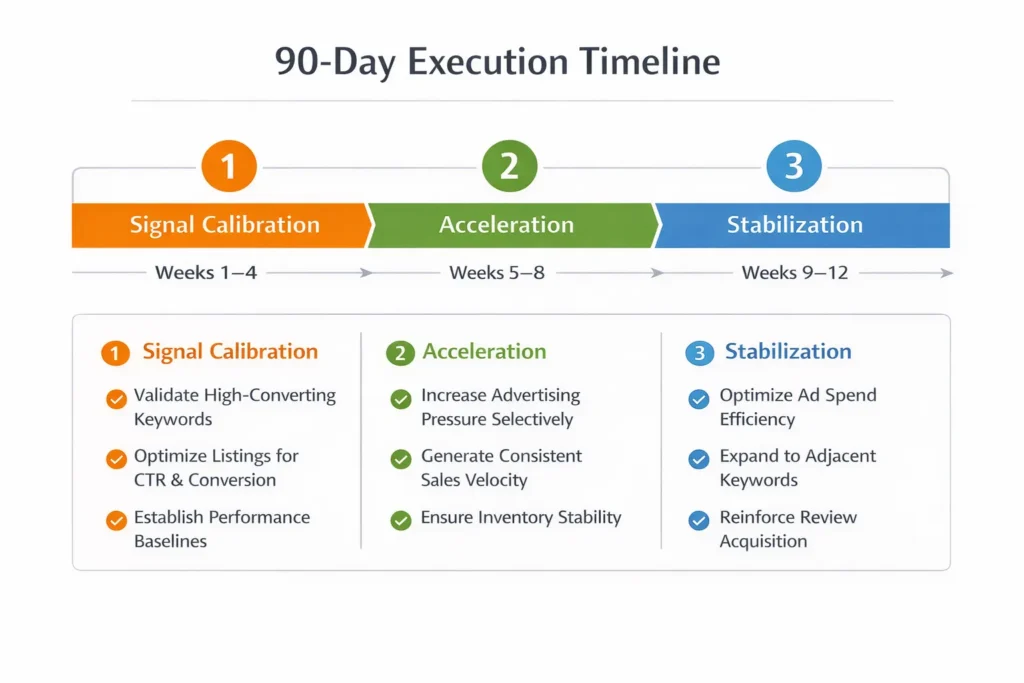
Phase 1: Signal Calibration (Weeks 1–4)
Refine keyword architecture based on revenue relevance, not just search volume. Implement a targeted Amazon advertising strategy to validate high-converting queries. Optimize the listing elements that influence click-through rate and conversion, including imagery, pricing presentation, and benefit hierarchy. Establish performance baselines.
Phase 2: Acceleration (Weeks 5–8)
Increase advertising pressure selectively on search terms that convert. Monitor Amazon sales velocity for consistency, not isolated volume spikes. Protect inventory stability and avoid abrupt campaign reductions that disrupt momentum.
Phase 3: Stabilization (Weeks 9–12)
Gradually reduce inefficient paid traffic while maintaining overall sales velocity. Expand into secondary keyword clusters supported by historical conversion strength. Reinforce review acquisition and brand authority.
Across all phases, the objective is not temporary ranking improvement. It is the accumulation of confidence within the Amazon search algorithm.
How to Do Amazon SEO Effectively
Now let’s translate all of this into a practical roadmap for optimization.
1. Build a keyword strategy the way Amazon expects
Amazon advises sellers to consider both short-tail and long-tail keywords: broad category terms for reach and specific phrases for higher conversion.
A solid keyword strategy for SEO for Amazon listings typically includes:
- Core category terms (e.g., “wireless earbuds”)
- Modifier-based long-tail terms (e.g., “noise-cancelling earbuds for travel”)
- Use-case or audience-based terms (e.g., “gym headphones for running”)
- Synonyms and alternative ways buyers describe the same item
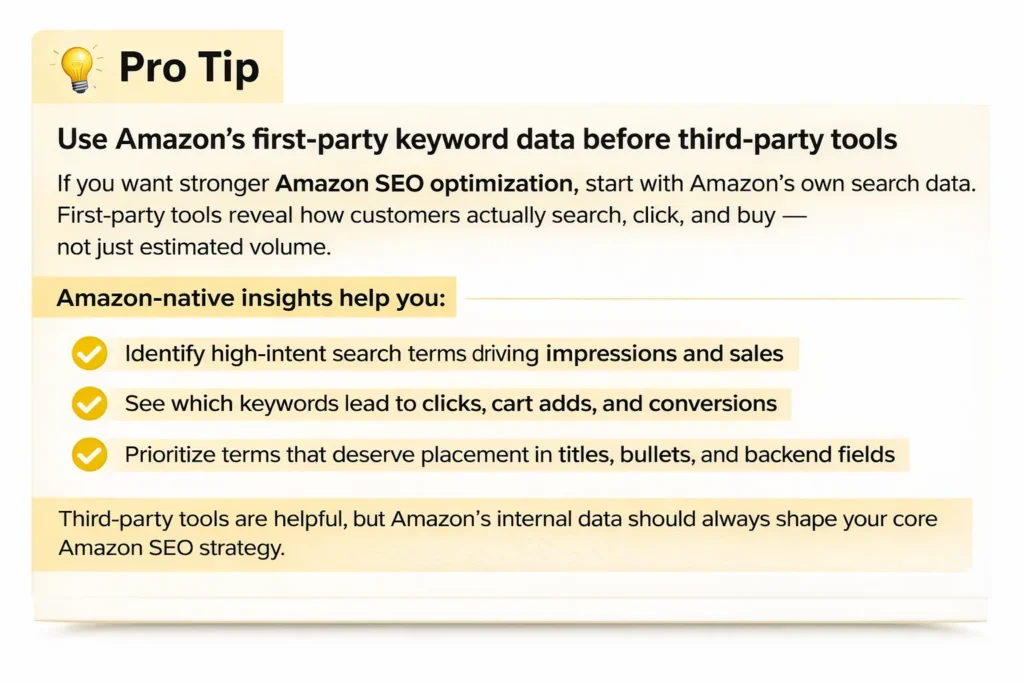
Amazon specifically points sellers to tools like Product Opportunity Explorer and Brand Analytics to track top search terms, query performance, and shifts in customer behavior — insights that are invaluable for refining your Amazon SEO strategy.
2. Turn that keyword map into a structured, human-friendly listing
Amazon’s own article breaks optimization into seven levers: keyword research, titles, descriptions, bullets, backend search terms, images, and pricing. Those map perfectly to how you should design your amazon seo guide.
- Title:
Your title is the most critical text element on your listing because it carries the highest indexing weight, influences click-through rate, and sets expectations before a customer clicks. Use your primary keyword, but keep the title concise, clear, and readable—especially if you’re applying proven Amazon listing optimization techniques across a full catalog. - Bullets:
Highlight key benefits, not just technical features. Amazon suggests starting each bullet with a short label, followed by a brief explanation written with the customer in mind. This is a great place for secondary keyword variants that support SEO for Amazon Webstore visibility. - Description:
Use this area to expand on benefits, materials, dimensions, care instructions, and warranty — all the details Amazon calls out as essential content for the detail page. Avoid keyword stuffing; Amazon explicitly warns that overusing the same phrase can hurt both experience and ranking. - Backend search terms:
Treat these as overflow for keywords that don’t fit naturally on the front end: synonyms, abbreviations, alternative product names. Amazon’s guidance is clear: avoid duplicates, keep it relevant, and use spaces, not commas.
3. Optimize your conversion assets based on Amazon’s best practices
This is where improving Amazon SEO turns from theory into revenue.
Amazon’s blog emphasizes these points for images and content:
- Use a variety of images from multiple angles.
- Highlight key features visually.
- Use clear, well-lit photos on a plain white background, with the product filling at least ~85% of the frame.
- Use alt-text on images to describe what’s shown and include one to two relevant keywords — this helps both accessibility and SEO.
Layer A+ Content on top as your storytelling canvas. Amazon openly states that A+ Content can increase sales when used well, especially when it combines rich text, imagery, and comparison charts. For Amazon SEO optimization, treat A+ as a conversion tool: it should answer questions, reduce doubt, and move the shopper closer to “Add to Cart,” boosting the performance side of the equation.
Finally, your pricing strategy needs to make sense. Amazon recommends researching competitor prices, understanding your margins, and using tools like the Revenue Calculator and Automate Pricing to find the sweet spot where you stay competitive without destroying profitability.
Common Amazon SEO Mistakes to Avoid
From both Amazon’s guidance and real-world seller experience, some patterns show up again and again:
- Keyword stuffing everywhere.
Amazon explicitly calls this out as harmful: repeatedly using the exact phrase can make the copy unreadable and damage ranking. - Ignoring long-tail terms.
Sellers sometimes chase only the biggest-volume phrases. Amazon encourages using long-tail queries because they often convert better. - Weak or generic images.
Blurry photos, low angles, or lack of lifestyle imagery all sabotage conversion signals that feed back into your Amazon seller SEO performance. - Leaving backend terms blank or redundant.
Repeating your title keywords exactly in backend fields wastes valuable indexing space. - Overdesigning A+ Content.
Beautiful but confusing layouts can push customers away rather than guide them, hurting the conversion rate. - Set-and-forget listings.
In a marketplace that shifts monthly, never revisiting your content means letting competitors slowly outrun you.
Avoiding these pitfalls will keep your Amazon SEO optimization work from being quietly undone by minor but critical errors.
Amazon SEO in 2026 Is Performance Architecture
Amazon SEO is no longer a checklist task. It is performance orchestration.
It requires coordination between Amazon keyword research, listing persuasion, paid traffic deployment, pricing stability, and operational continuity. When these components align, organic visibility strengthens naturally. When misaligned, visibility becomes dependent on advertising support.
Sellers who understand this shift stop asking how to rank higher on Amazon and begin asking how to build ranking momentum that competitors cannot economically disrupt.
Sustainable Amazon search rankings are not hacked. They are engineered.
Why Strategic Amazon SEO Requires Structural Expertise
As brands scale, the margin for error narrows. What functions at moderate revenue levels often fracture under category pressure and rising advertising costs. Amazon’s SEO strategy at scale becomes a matter of capital allocation, profitability protection, and competitive defense.
If organic visibility collapses without paid pressure, the system requires recalibration. Durable dominance demands integration between Amazon listing optimization, Amazon PPC strategy, conversion rate discipline, and inventory management.
The brands that lead in 2026 are not reacting to algorithm shifts. They are aligning performance systems to continuously reinforce algorithmic confidence.
Visibility built on momentum becomes difficult to displace. Visibility built on force becomes expensive to maintain.
The difference defines long-term profitability.
FAQs
Amazon SEO is the process of improving a product’s visibility in Amazon search results by aligning keyword relevance with performance signals such as click-through rate, conversion rate, and sales velocity. In 2026, Amazon SEO is driven less by text placement alone and more by sustained buyer behavior and revenue efficiency.
The Amazon ranking algorithm evaluates relevance first, then prioritizes performance signals that indicate marketplace efficiency. Key factors include click-through rate, conversion rate, consistency in sales velocity, inventory stability, pricing behavior, and overall buyer response compared to competing listings targeting the same search terms.
Amazon PPC can indirectly support Amazon SEO by driving sales and engagement for targeted keywords, thereby improving organic rankings. However, PPC only strengthens SEO if conversion performance remains strong and sales velocity stays consistent when spend is adjusted gradually rather than reduced abruptly.
Amazon SEO timelines vary by category competition and listing strength, but meaningful ranking momentum typically develops over several weeks to a few months. A structured 60–90-day approach is often required to build stable signals across click-through rate, conversion rate, and sales velocity.
The most important Amazon SEO factors include keyword relevance, click-through rate, conversion rate, sales velocity consistency, inventory stability, pricing discipline, review credibility, and listing quality. These signals collectively influence how Amazon allocates search result visibility.
Related reading: Number of Keywords You Can Use Amazon Listings (2025 Guide) · Amazon SEO Optimization: Keyword, Listing, and Conversion Optimization Tips